Tuesday, December 14, 2010

Drawing Final (Arts 007)

Here are pictures of mine and my classmates' final art piece:

"Skin"

Shoes that showcase each person's personality 


At first glance I thought these were breasts. But then I took another look at it and they were candles instead. The candles represent finding one's path towards a certain goal.

Americans and Chess

My favorite piece of the gallery!  Artist: Krista


Musical theme


Wednesday, December 8, 2010

2nd Interview with David Ho

I interviewed David Ho another time for a more in-depth look at graphic design careers. 

1.What personal attributes are essential for success in graphic designing?
Attention to detail.. and the ability to visualize what your client wants.

2.What parts of your job do you find most challenging? What do you find most enjoyable about your job?
Meeting deadlines. The most enjoyable is seeing your work published in newspaper, magazine, and other related media.

3.What organization/company can might me interested in hiring a graphic designer?
Corporate office with internal marketing department. Magazine company, newspaper, online companies that requires daily updates like eBay or even facebook :-)

4.When you first got into this field/major did you know that you would be working in the environment you are working in right now?
Some what. When I started, I worked for Cornish and Carey Residential Corporate in San Mateo in the marketing department. Scratch that that was my second job. First graphics job was at Kinko's in Concord.

5.Do you like the work space/environment you are in? Why/why not? Yes and No. I work for a small company, which makes me feel important because I can make important decision without the red tape. Unlike bigger companies, you have to get approval from multiple managers before a simple task is implemented. Con, is that sometimes I have to work longer hours :-)

6.What kind of compensation could a first year graduate graphic designer expect? It really depend on what sector you are getting in to... On average a designer can expect to earn 35K the first year. However, you may get in the 40's if you sign on with a big company that may offer stock option.

Critiquing "The Mulberry Tree"


Vincent Van Gogh is famous for using bold colors in his artworks.  In 1888, Van Gogh moved to Arles, Provence where the beautiful landscapes inspired him to capture its beauty in his paintings.  In capturing these landscapes, Van Gogh exaggerated the colors and used bold expressive lines, which contributed to the modern art era. 

His work, The Mulberry Tree is one of the many paintings he did in Arles, Provence.  The intention of this piece was to emphasize the bright color and bold strokes of the landscape, in contribution to the modern art paintings.  The Mulberry Tree clearly achieved Van Gogh’s intention—its bright yellow emphasizes the tree’s extravagant beauty and the bold strokes details the landscape.  In addition, Van Gogh’s bold stroke of lines, which follows the contours of the objects in the painting, creates this sense of movement in the picture, especially the tree.  The wild curvilinear strokes on the tree indicate that nature is not in a perfectly static state; instead, nature is wild and ever changing.  

When I first saw this work, it captured my attention from all of Van Gogh’s other works because of the use of colors and lines.  Van Gogh’s intention of bringing out the bright yellow really captured my attention to this painting—the yellow stands out to the eye, and it stays in my memory.  The lines also add the affect of being wild and crazy as they are not straight static lines, which would represent stability, but rather bold curvilinear and organic lines.  Nature in general is wild; it’s out in the wild land and is in a sense, untamable.  The overall composition is of organic lines and shapes, which says a lot about nature because, organic shapes represent “natural objects” which are not man-made or structured for a specific purpose.  

The picture overall is balanced.  By centering the tree on the page, and emphasizing it using a bright yellow, Van Gogh draws the audience‘s attention to the tree’s importance.  The wild bold strokes on the tree move the audience’s attention towards the light yellow field in the background then the blue sky.  The bold lines creates rhythm in the painting too since they are repeated throughout the painting.  Van Gogh uses the rule of third to compose the picture.  Even though the tree’s trunk is centered right in the middle, its branches and leaves are not; instead, they are a wildly spread throughout a little bit more than 2/3 of the painting.  

The Mulberry Tree is one piece that artists can evaluate and critique.  It's a great piece to look at and view Van Gogh's work.  

Knowledgeable and Creative Artists

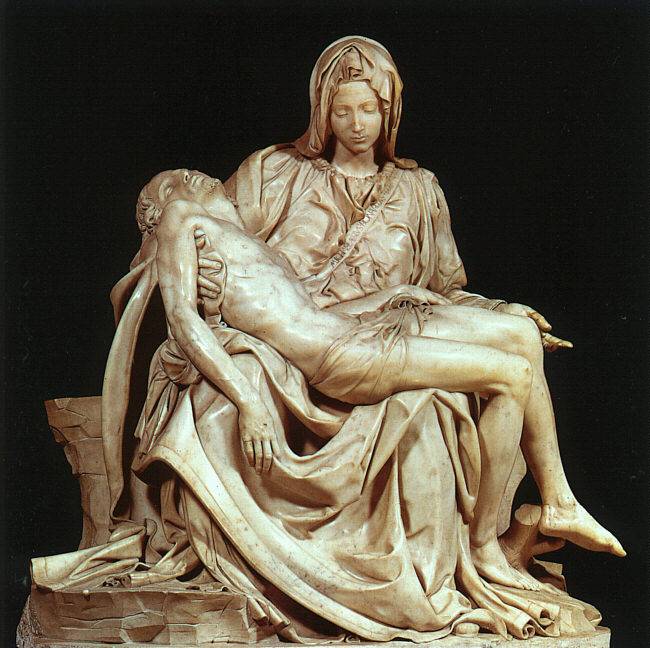
Michelangelo's Pieta


Peter Chan's half-minute horror
One knowledgeable artist is Michelangelo Buonarroti, best known just as Michelangelo.  He is best known for his elegant sculptures, especially David.  At a young age, Michelangelo went to study anatomy at the Garden of San Marco.  There, he studied dead bodies and their form.  His anatomical studies eventually led him to be very knowledgeable of the human form.  This then further his understanding of the human body, which resulted in beautiful realistic sculptures in his careers.  For example, by looking at Michelangelo’s Pieta, a sculpture of Mary and Jesus, the audience knows that Michelangelo knows how the human form must look like, how drapes fall on a person, and the facial expression of the subjects.  The drapes on the forms look so detailed and the rendering so delicate it the audience automatically knows that Michelangelo has to have some lesson or knowledge about the human form and fabrics in order to create a piece that looks realistic.
A creative artist that I’ve been following is Peter Chan.  Most of Chan’s works are on the comedian side.  He takes a subject or an idea and twists it into his own.  In a collaboration work between him and his friend, Bobby Chu, both used the concept of a horror movie and imaginatively create another concept of the ‘horror’ in a movie.  By looking at the illustration, known as ‘half-minute horror,’ the audience (us) notices that the people in the theater are horrified by whatever is on the screen.  However, what is more horrifying to the audience (us) is looking at the image is the people’s mouth; inside each person’s mouth is a mini monster drinking or eating whatever substance the people were putting in their mouth.  Creativity is using a general known concept and pushing yourself to imaginatively make a new idea out of it; that is what Peter Chan did.  So instead of sticking to the regular movie concept, illustrating a crowd of people watching a horror movie, Chan creates an image that interacts with the audience—playing with the audience’s emotions.  When the artists do this, playing on their audience’s emotion, or somehow ‘awing’ them with a new idea, he or she is creative.


Tuesday, December 7, 2010

Drawing Finals

Yay, done with my drawing final today! 

The art studio looks amazing today.  For our final piece, we were required to display our drawing/s on the walls of the art studio, with additional items such as our 20 sketches and an artists statement.  This is a good practice for art students who needs to learn how to showcase their works.  Here's what I learned about displaying artworks:
  • Presentation is key
  • Being neat and organize = good 
  • Hang your artwork the way you think will best express to the audience the theme/message 
  • When displaying  your work, find another group of artists who have a similar theme to your own; thus, your presentation is cohesive 
    • Only one group in the class made the display work as a whole 
  • Try to make your piece stand out by clearing away any clutters or mess that may get in the way of your art 
    • This is quite important because if you leave these items near your piece, it is sending a message to the audience that the items belong with your piece 
We were given the chance to walk around the "art gallery" and look at each others' artwork, sketchbook, and personal statement and comment on their work with honest critiques.  I found many of my classmates' ideas and concept very unique.  I especially liked the one that made a connection between shoes and personality.    The artworks were beautiful too.  My favorite piece has to be Krysta's.  She spent tons of hours working on both her pieces and just by looking at it, I'm simply awe and speechless because it's beautiful.  I don't have pictures up yet but then when I do, you guys will feel the same way too!

Pacific students should definitely not miss out on the display in the art studio; it's a once in a life time opportunity to see these people's work go up on display (we have some students with awesome art skills who are not art majors!)

I'll leave my own final drawing to tomorrow's talk because it would be much better if there's a photo of it.

Overall, I really enjoyed this art class.  In the beginning of the school year, this art class was my least favorite class.  I dread coming to it because it was challenging and I did not like the professor's teaching.  However, I found my perception changed once I got to know the class and teacher better.  I recommend Professor Hunt's class for Pacific drawing class if anyone is interested because it is well taught and quite challenging.

Monday, October 11, 2010

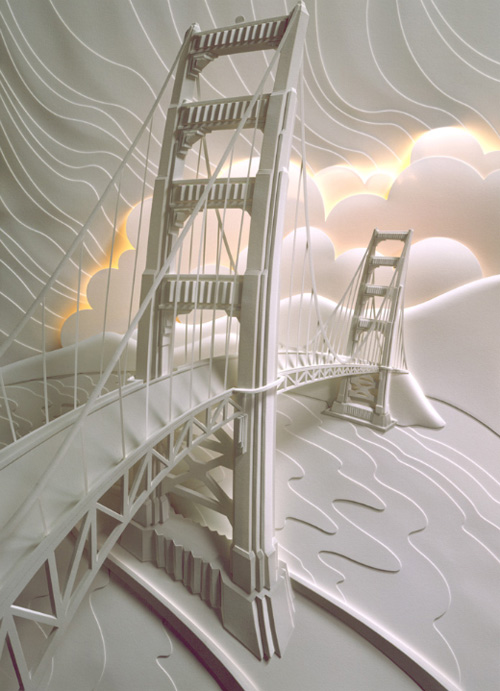
Look What I Stumbled Upon: Paper Art!

I found a superb artist skilled in paper crafting.  Jeff Nishinaka. All his works are made of paper and it is amazing how he can manipulate the folds of paper to create stunning images.  I somehow stumbled upon one of his artwork and was so intrigue in it I just had to googled him.  I'm so glad I did because before all this, I didn't even know that Paper Sculptures exists!

You can check out his website at http://www.jeffnishinaka.com/


Meanwhile, here are some of his works:


Exquisite, right?  I encourage you guys to look at other paper artists/sculptures because they're beautiful too. 

Wednesday, October 6, 2010

Knowledge and Creativity, Which One Came First?

Knowledge Arouses an Artist’s Creativity
            Artists subconsciously use their general knowledge to generate a sense of creativity within their artworks.  So what then is knowledge?  What is creativity?  And how do these two components correlate?  Knowledge is the basic understanding of a particular subject, such as the knowledge of a flower—how it looks when it blooms, what type of environment it need to be in, and etc.  Creativity is the artist’s wild imagination.  It is the risk of doing outrageous things with a medium, challenging the audience with its visual impact.  The word creativity is so broad ranged that it is indescribable.  However, I will try to do just that (describing the meaning of creativity) to the best of my ability.  I, as an amateur artist, also use my knowledge of how shadows fall on a shape to create a piece of work with the correct values and lights. All artists, therefore, do not create products out of the bloom (and if there is such artists, there are only few), but also uses their knowledge of the world around them to creatively craft a piece. 
            According to my understanding, knowledge is to be familiar with facts, studies, or guideline of things.  Knowledge is important to every one in any professional.  When someone is knowledgeable in a particular subject he or she can use that knowledge to his or her advantage in their professional.  For example, a chef needs to know all the basic ingredients of a food: how it tastes and how to cook it in order to create a recipe that the public likes.  In general, knowledge is the basic erudition a person has of the world.  People need knowledge to function in the world. 
            Creativity is utilizing traditional and known information (knowledge) to form new innovated ideas that is meaningful and imaginative.  Solving a problem requires general knowledge.  Whether its finding a resolution of how to fix a person’s heart, an answer to a math problem, or building an art piece, everyone employ knowledge to do these things.  Once a person knows how something is work, or is, the individual will use that understanding to creatively solve a problem.  An example is Michelangelo.  He uses his own observation and investigation of the human form and applied it his large marble sculpture, David.  David illustrates the detailed studies Michelangelo since his human anatomy is like that of a real person. 
            In conclusion, knowledge and creativity go hand in hand.  Without Knowledge, creativity cannot be formed.  Once a person is acquaintance with a subject, he or she is able to use that understanding and creatively make something out of it.  Creativity cannot come out of itself without some basic understanding of the world.  Therefore, we go to school to learn and gain some knowledge of the world so we can thus, creatively innovate something new.   

Saturday, September 18, 2010

An Interview With a Graphic Designer

For my Freshmen Seminar Art class assignment, I was to interview an artist.  I decided to interview my aunt's boyfriend, David Ho, whose a graphic designer, working at REPS (Real Estate Promotional Services).  His main job is to create design ads for real estate agents who want to sell houses for customers.  Here's the interview:

Hi Brenda,
I hope I answered all of them...It's getting late and I think I might not be thinking right.... so, look through it and let me know if you need me to re-answer or elaborate any of the answers. Thanks.

When did you become interested in the art field and why?
It started in high school, I didn’t really know what I want to be--All I know is that I wanted something creative. In my senior year, I enrolled in a graphics ROP class, also known as regional occupational program. This program allows students to earn school credits while learning trade skills in a real job environment (almost like, internship).

After taking that class, I knew I wanted to continue on that study. Especially, when I found out that you can make a living creating art using computers. During that time frame, most companies were making the switch from cut and paste method to computer based layout.

One the side note: My parents did not approve me in studying art, because they thought I would end up selling paintings on a street --- to prove them wrong I continued my study and applied for a job in the art field.

What challenges did you go through in college/school in order to get to where you are today?
In this field, you always need to update your software skill. Especially, when new software or updates are coming out every six months or so. I can’t really think of any challenges when I was going to school--except the challenge now is trying to keep up with all new software updates.

For a job interview, what did you have in your portfolio? Do you constantly change your portfolio to fit the job description, or did you show the employer all your past works?

For a job interview I would have actually completed projects I did including mistakes that I have done. So, I can explain to the employer why a particular piece is wrong. I also, will have an interactive CD with my art pieces that I would leave behind.
Yes, I typically do change my portfolio to fit the job description.

Do you enjoy what you do as a graphic designer? Why/why not?
I do enjoy being a graphic designer, however at times it can be very stressful. Especially, with the deadlines you need to meet. In this field, you don’t create artwork for yourself or set your own deadlines. The client is always right, especially when they are paying you.

Or if you could do it all again, would you switch your focus onto another major?
No, I wouldn’t change my major. But, I would add on to what I learned.

How do you deal with critiques?
In this business, you have to have a thick skin--being able to take critiques is very important. If you can’t take critiques, then this is not a field you should get into. I would say 99% percent of the time your design will change from what you started out at. The client will critique the design and change it to their concept.

What school did you go to and why?
I started at a JC, but after a year -- I went to a technical school (Silicon Valley College) to finish up my degree, because I wanted to get into the field sooner. However, years later I find myself going back to school to get a different degree. But this degree does balance out my graphics degree.

Because there are trends in the art field, do you keep up with them, or do your own thing?
Yes, I try to keep up with the trends, but at times it is a good idea to do your own thing--that is how a trend get started. Your idea, can be the next trend.

What advice would you give if I want to get into a graphic design/art field? Or, how should I prepare for a graphic design/art career?
To be honest, everyone is different. If you are really interested in this filed, I would try internship. Also, depending on what sector you are entering I would focus your attention to those type of design. For example, if you are interested in motion graphics--then I would study 3-D animation, rendering techniques, sound editing, etc.

What inspires you to become an artist/graphic designer before you came into the art field, when you were in the art field, and after landing a career in REPS? Meaning, do you have any muses that inspires your work?
Nature inspires me, at times, when I’m hiking or wondering outside I would see things that I would like to incorporate into my design. For example, if I see a telephone pole I would think its kind of unique. I would be thinking to myself, I can use the color/texture of the log as a background.

Are there any challenges you face in your job? Please explain.
There are many challenges that comes with this job from technical to non technical. For example, trying to color match offset print to fiery digital print.

As a graphic designer you deal with customers, do you suggest I also minor in business (if I were to major in the art field)?
I would highly recommend you minor or major in business or something that accompany your graphics degree. For example, I went back to school and got a BS in CIS (computer information system) --- with those degrees I can apply for UX/UI Designer position or Web Designer position.
Business major with graphics is a very good idea, especially if you plan to start your own business some day or even apply for management position, like Marketing Director.

Thank you, David for the awesome interview! :)
I'll be sure to note all these answers into mind before deciding on the major.  You can also check REPS's website and see David's design at: http://www.repsweb.com/

*Other than that, please comment on this blog on any thoughts, questions, concerns, art information, etc. you might have.  Comments are greatly appreciated!  
 

Friday, September 17, 2010

Purpose of Blog

Hi everyone! :)

Just a quick bio on me:

I am a student at Univ. of the Pacific.  This will be my first year attending Pacific, and I look forward to the coming days! ^^  As of now, I am a Visual Arts major (who still can't decide between graphic design or studio art).  Pacific requires all Visual Arts major students to take a Freshmen Seminar Art class with the art professor Brett DeBoer.  This class focuses on what students can do with an art career, and how they can pursue it.  It is design to help students with their major.  As part of this class's assignment, my classmates and I were to set up a blog online that talks about our feelings/thoughts/criticism/discovery of all types of artwork and make it an interactive blog between the readers (you) and us.

I hope that this will kind of  "push" you guys who are reading this to talk to me about art related subjects and interact with my postings.  I look forward to comments! :)